

PDF chapter test TRY NOW
Look at the picture below; there are different coloured leaves, aren't they?
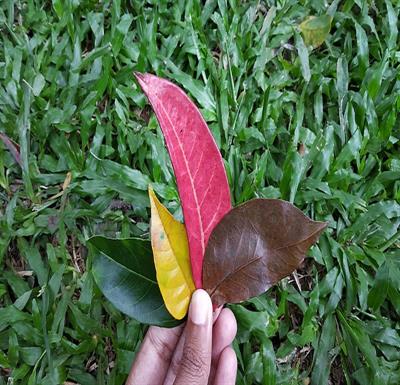
Different colours of leaves based on the pigments
Do process of photosynthesis occur in colour leaves other than green leaves?
Let us test the leaves which are not green in colour, whether they do photosynthesis or not.
Steps followed:
- Take one or more plants, one with green leaves and the other with different colour leaves.
- Remember that the plants undergoing photosynthesis have stored carbohydrates in them.
- Performing an iodine test will prove that leaves other than green in colour also have stored carbohydrate in them.
- Iodine, in the presence of starch, turns into a blue-black colour.
- But if the leaf does not turn blue-black on iodine's addition, then it proves it does not do the photosynthesis.
Observation:
- Blue-black colour is observed in the green parts of the leaf — indicating the presence of starch and thus photosynthesis.
- No blue-black colour is observed in the non-green parts without chlorophyll — indicating no photosynthesis there.
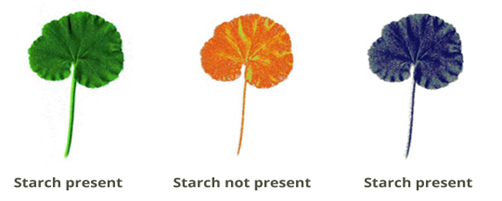
Presence of starch in different types of leaf
Important!
Info box: Plants with non-green leaves also perform photosynthesis. They contain other pigments such as anthocyanins (red or purple) and carotenoids (yellow or orange) in addition to chlorophyll.These pigments may mask the green colour, but chlorophyll is still present and responsible for photosynthesis.
Anthocyanins present in large amount coverup the green pigment chlorophyll.
However, the covered-up chlorophyll continues to perform its function of carrying photosynthesis. Hence colour leaves also involve in the process of photosynthesis. The colour varies from red, orange, and yellow due to carotenoid's presence, which is abundantly found in flowers and fruits.
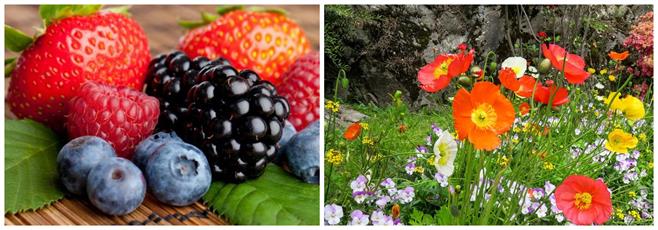
Fruits and flowers
Reference:
Wikipedia - https://commons.wikimedia.org/wiki/File:Leaves_of_different_colours.jpg
 Register for free to see more content