


PUMPA - SMART LEARNING
எங்கள் ஆசிரியர்களுடன் 1-ஆன்-1 ஆலோசனை நேரத்தைப் பெறுங்கள். டாப்பர் ஆவதற்கு நாங்கள் பயிற்சி அளிப்போம்
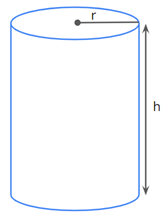
Book Free DemoA cylinder has two plane ends. Each plane end is circular, and these two plane ends are parallel to each other.
Also, a cylinder has two dimensions, namely radius and height.
The net of a cylinder looks like this.
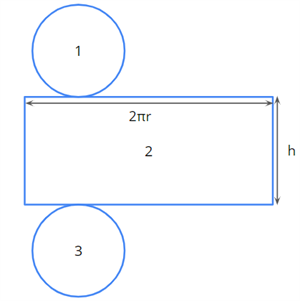
\(\text{The total surface area of a cylinder}\) \(=\) \(\text{Area}\) \(1\) \(+\) \(\text{Area}\) \(2\) \(+\) \(\text{Area}\) \(3\)
\(= \pi r^2 + 2\pi rh + \pi r^2\)
[Since \(\text{Area}\) \(1\) and \(\text{Area}\) \(3\) are circles]
\(= 2\pi r^2 + 2\pi rh\)
\(= 2\pi r(r + h)\)
Let us now look at the lateral surface of the cylinder.
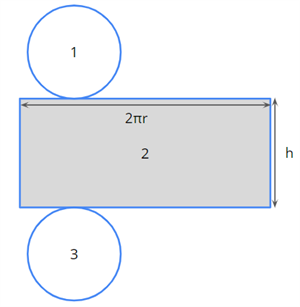
The shaded portion forms the lateral surface of the cylinder.
\(\text{The lateral (or curved) surface area of a cylinder}\) \(=\) \(\text{Area}\) \(2\) \(=\) \(2\pi rh\)
 Register for free to see more content