


UPSKILL MATH PLUS
Learn Mathematics through our AI based learning portal with the support of our Academic Experts!
Learn more\(ABCD\) is a quadrilateral in which \(AB = AD\), the bisector of \(\angle BAC\) and \(\angle CAD\) intersect the sides \(BC\) and \(CD\) at the points \(E\) and \(F\), respectively. Prove that \(EF \parallel BD\).
Proof:
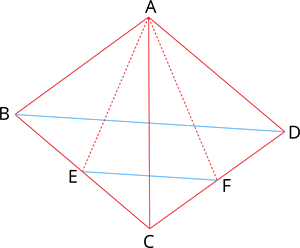
In \(\triangle ABC\), \(AE\) is the bisector of \(\angle A\). Then, by angle bisector theorem, we have:
\(\frac{AB}{AC} = \) ---- (\(1\))
In \(\triangle ACD\), \(AF\) is the bisector of \(\angle A\). Then, by angle bisector theorem, we have:
\(\frac{AC}{AD} = \) ---- (\(2\))
It is given that \(AB = AD\). Substituting it in equation (\(2\)), we get:
\(\frac{AC}{AB} = \)
\(\frac{AB}{AC} = \) ---- (\(3\))
From equations (\(1\)) and (\(3\)), we get:
\(\frac{BE}{EC} = \)
Applying the converse of Thales theorem, then,
\(EF \parallel BD\).
Hence, we proved.
 Register for free to see more content