

PDF chapter test TRY NOW
Immunity:
The body’s ability to fight against diseases and protect us from infections.
When pathogens enter, the immune system immediately begins to fight them. It does this through white blood cells (WBCs), which act like soldiers.
Types of Immunity:
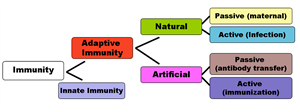
Types of immunity
It is mainly of two kinds: Innate Immunity and Acquired Immunity.
| Innate Immunity | Acquired Immunity |
|---|---|
| Natural defence present from birth and provides immediate protection against pathogens. | Defence developed after exposure to pathogens or vaccination. |
| Non-specific response against all kinds of pathogens. | Highly specific response against particular pathogens. |
| No immunological memory; response remains the same on repeated exposure. | Has immunological memory; responds faster and stronger on subsequent exposure. |
| Provides short-term protection. | Provides long-lasting protection. |
| Examples: Skin acts as a physical barrier; fever and phagocytic cells help destroy microbes. | Examples: Polio vaccine immunity; recovery from chickenpox; antibodies received from mother’s milk. |
Importance of immunisation:
The immune system responds to invading pathogens but may not always be strong or fast enough to prevent infection.
- Immunisation helps protect the body against harmful infectious diseases.
- It strengthens the body’s natural defence mechanisms.
- It is a cost-effective method to prevent the spread of infections.
- When a large population is immunised, it reduces disease transmission in the community.
- This also helps protect individuals who are not vaccinated through herd immunity.
The first artificially made vaccine used in the world:
A thousand years ago, healthy people inhaled powder made from smallpox scabs to gain protection from smallpox. Those who practiced this were called teekedaars. This was the earliest known form of vaccination.
Important!
In modern medicine, Edward Jenner introduced the process of vaccination in the year \(1796\). According to the World Health Organisation (WHO), the Jennerian vaccination has eliminated smallpox from the human population.
Before learning about vaccines, it is essential to understand key terms such as antigen and antibody.
- When a disease-causing microorganism enters the body, it produces substances that aid our bodies in recognising the microbe as a foreign agent. This substance is called an antigen.
- When an antigen enters the body, it stimulates the production of substances that help fight microbes. These substances are called antibodies.
Vaccine:
Vaccines are preparations of living or killed microorganisms or their products used to prevent or treat diseases.
Vaccines are of two types: live vaccine and killed vaccine.
- Live Vaccines: They are prepared from living organisms. The pathogen is weakened and administered. The examples include the BCG vaccine and the oral polio vaccine.
- Killed Vaccines: Microorganisms (bacteria or viruses) killed by heat or chemicals are called killed or inactivated vaccines. They require a primary dose followed by a subsequent booster dose. The examples include the typhoid vaccine, cholera vaccine, and pertussis vaccine.
Dr Maharaj Kishan Bhan was an Indian scientist who developed the Rotavirus vaccine and promoted affordable healthcare through biotechnology.
How does it work:
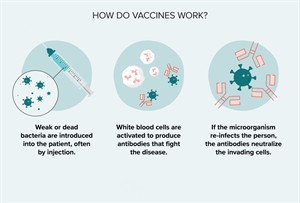
Action of vaccine in human body
Types of vaccine and diseases:
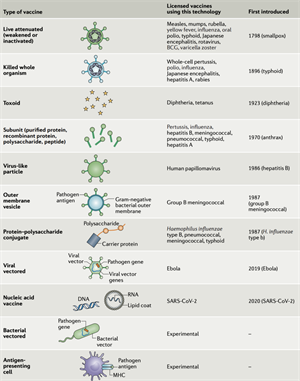
Vaccine types for different diseases
Treatment of diseases:
In \(1928\), Alexander Fleming discovered that a green mould (Penicillium notatum) contaminated his bacterial cultures and inhibited bacterial growth. He found that the mould killed many bacteria and named its antibacterial substance penicillin, the first antibiotic.
Microorganisms are the source of antibiotics and vaccines.
Antibiotics:
The word "Antibiotic" is derived from the Greek words "anti", which means "against," and "bios", which means "life" (a bacterium is a life form).
Answer:
Antibiotics are medications used to kill or inhibit the growth of disease-causing microorganisms.
There are microorganism-derived products that are taken as pills, capsules, or injections. Primarily, bacteria are used in manufacturing antibiotics. Nowadays, many fungi and algae are also being used.
Penicillin, streptomycin, erythromycin, and tetracycline are common antibiotics produced from fungi and bacteria. They are used to treat various infections, prevent diseases in livestock and poultry, and control some plant diseases. However, antibiotics do not work against viral infections like cold and flu; antiviral or antifungal drugs are used instead.
Measures to use the antibiotics:
- It is essential to note that antibiotics can only be used under the supervision of a trained physician.
- It is necessary to complete the entire course prescribed by the doctor.
- If you take antibiotics when you don't need them or in the wrong doses, the medication can become less effective.
- Antibiotics taken unnecessarily can also destroy the body's beneficial bacteria.
Antibiotics respective to their organisms:
|
Class
|
Type
|
Antibiotic
|
| Bacteria | Streptomyces griseus | Streptomycin |
| Bacteria | Streptomyces erythreus | Erythromycin |
| Bacteria | Bacillus subtilis | Bacitracin |
| Fungi | Penicillium notatum | Penicillin |
| Fungi | Cephalosporium acremonium | Cephalosporin |
Antibiotic resistance:
Antibiotic resistance occurs when bacteria change and become able to survive even after being exposed to antibiotics that are used to kill them.
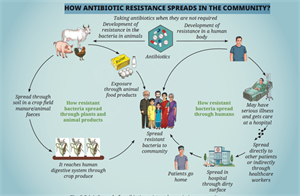
Spread of antibiotic-resistant bacteria in the community
How does it happen?
- Overuse: Taking antibiotics even when not necessary (such as for colds and flu, which are viral infections).
- Misuse: Not completing the full course of antibiotics the weak bacteria to die, but the stronger ones survive.
- Livestock use: In many places, antibiotics are administered to animals to promote faster growth and weight gain. It can create resistant bacteria that spread through food.
- Global spread: Resistant bacteria can travel from one person to another and across countries.
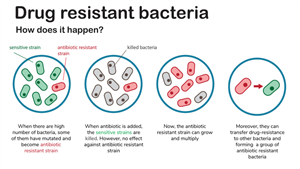
Stages of Drug resistant bacteria
Consequences:
- Infections last longer and become harder to treat.
- Once curable diseases (like \(TB\)) may become life-threatening.
- Hospitals face "superbugs" like MRSA (Methicillin-resistant Staphylococcus aureus).
Prevention and responsible use:
i. Take antibiotics only with a doctor’s prescription.
ii. Always complete the full prescribed course.
iii. Never share or reuse leftover antibiotics.
iv. Wash hands and maintain hygiene to prevent infections in the first place.
i. Take antibiotics only with a doctor’s prescription.
ii. Always complete the full prescribed course.
iii. Never share or reuse leftover antibiotics.
iv. Wash hands and maintain hygiene to prevent infections in the first place.
India has long sought to strike a balance between modern and traditional approaches. Alongside allopathic medicines (such as antibiotics), traditional systems of medicine play a crucial role.
Traditional Medicine:
Knowledge, skills, and practices based on centuries of experience using natural herbs, diet, exercise, and lifestyle to prevent and treat diseases.
- Ayurveda is an ancient Indian system that promotes balance of body, mind, and spirit using herbs like Ashwagandha, Tulsi, and Neem, along with preventive lifestyle practices.
- Lifestyle medicine such as healthy diet, regular exercise, and proper sleep helps prevent diseases and reduces dependence on strong medicines and antibiotics.
- Modern and traditional medicine can complement each other (e.g., vaccines with Ayurvedic support), while organizations like AYUSH (Ayurveda, Yoga, Unani, Siddha, and Homoeopathy) promote safe integration, especially in the face of rising antibiotic resistance.

Traditional Medicine, exercise and AYUSH
 Register for free to see more content