


PDF chapter test TRY NOW
Many living organisms around us are so small that the human eye cannot detect them without aid, yet they play an important role in nature and our daily lives.
What Are Microorganisms?
Microorganisms are very small living organisms that can be seen only with a microscope.
-
Micro means very small and Organisms means living beings and they are also called microbes.
-
Found everywhere: air, water, soil, food, and inside our bodies.
Just as we learnt earlier that cells vary in shape and structure, we now understand that some entire organisms are made up of only one cell and still carry out all life processes.
In the previous section, we studied that cells differ in shape, size, and structure depending on their function. This concept extends further in microorganisms.
Activity 1:
Aim:
To observe microorganisms present in pond or stagnant water using a microscope and understand their diversity.
Procedure:
- Collect pond or stagnant water in a clean container with the help of a teacher or elder.
- Using a dropper, transfer a small drop of the collected water onto a clean microscope slide and gently place a coverslip over it to avoid air bubbles.
- Place the slide under the microscope, adjust the focus, and observe the sample carefully for the presence of microorganisms.
Observation:
Under the microscope, we observe tiny microorganisms showing different shapes (irregular, oval, elongated) and movements, with some appearing green due to chlorophyll. We commonly identify organisms like Amoeba (irregular and changing shape), Paramecium (moves using hair-like structures), and algae (green and photosynthetic).
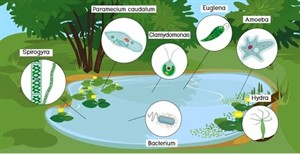
Microorganisms in pond
Classification of microorganisms:
Biologists group them into five classes.

Classification of microorganisms
1. Bacteria
Bacteria are microscopic, single-celled organisms that thrive in diverse environments. These are the most simple unicellular organisms, with rigid cell walls similar to those found in plant cells.
- The size of the bacteria ranges from \(0.0002−0.01mm\).
- Show different shapes such as spherical (cocci), rod-shaped (bacilli), and spiral
- Some are useful (e.g., help in digestion, nitrogen fixation), while others cause diseases
- The examples are Lactobacillus, Escherichia coli.
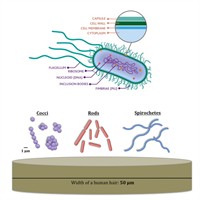
Bacteria
2. Viruses
Viruses are acellular (non-cellular) particles that show characteristics of both living and non-living things.
- Do not have acellular structure and they become active only inside a host cell,
- Can infect plants, animals, and bacteria and are responsible for many diseases.
- The examples are Influenza virus, HIV, coronavirus.
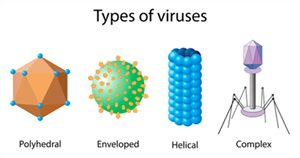
Viruses
3. Protozoa
Protozoa are unicellular, animal-like microorganisms that usually live in water or moist environments.
- Show movement using structures like pseudopodia, cilia, or flagella.
- Feed on other microorganisms and some are free-living, while others are parasitic.
- The examples are Amoeba, Paramecium, Plasmodium.
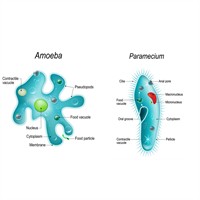
Amoeba and Paramecium
4. Algae
Algae are simple plant-like organisms that contain chlorophyll and can perform photosynthesis.
- Found mostly in aquatic environments and they can be unicellular or multicellular
- Produce oxygen and form the base of aquatic food chains.
- The examples are Chlamydomonas and Spirogyra.
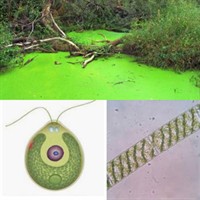
Chlamydomonas and spirogyra
5. Fungi
Fungi are mostly multicellular organisms that lack chlorophyll and obtain food from dead or decaying matter.
- Grow as thread-like structures called hyphae and they act as decomposers in the environment.
- Some are useful in food production, while others cause infections and they prefer warm and moist conditions
- The examples are Bread mould (Rhizopus) and yeast.
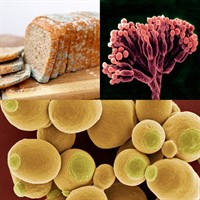
Bread mould, Penicillin and yeast
Microbes are
- Unicellular (e.g., bacteria such as Escherichia coli and protozoa like Entamoeba coli).
- Multicellular (Algae and Fungi).
- Acellular (not composed of cells-Virus).
Unicellular and Multicellular Organisms:
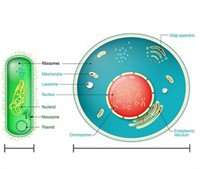
Unicellular and Multicellular
| Feature | Unicellular Organisms |
Multicellular Organisms
|
|---|---|---|
| Number of cells | Made up of a single cell | Made up of many cells |
| Body organisation | One cell performs all life functions | Different cells perform specialised functions |
| Level of complexity | Simple in structure | Complex in structure |
| Growth | Growth occurs by increase in cell size | Growth occurs by an increase in the number of cells |
| Nucleus | May not have a true nucleus (e.g., bacteria have a nucleoid) | Have a well-defined nucleus in cells |
| Examples | Bacteria, Amoeba, Paramecium, Yeast | Humans, plants, animals, mould |
Activity 2:
Aim:
To observe microorganisms present in soil using a microscope.
Procedure:
- Collect moist soil from a nearby field or garden in a beaker using a spoon or gloves.
- Add water to the soil and stir it with a glass rod to form a soil suspension; allow the mixture to settle.
- Take a drop from the clear top layer using a dropper, place it on a slide, add a coverslip, and observe under a microscope.
Observation:
We observe tiny moving organisms of different shapes, similar to those seen in pond water, indicating the presence of microorganisms such as bacteria, fungi, and algae.
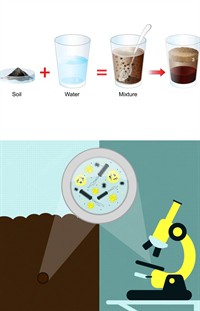
Observation of soil suspension under the microscope
 Register for free to see more content