


PUMPA - SMART LEARNING
எங்கள் ஆசிரியர்களுடன் 1-ஆன்-1 ஆலோசனை நேரத்தைப் பெறுங்கள். டாப்பர் ஆவதற்கு நாங்கள் பயிற்சி அளிப்போம்
Book Free DemoHow are we connected to microbes?
- Human beings live in constant interaction with their surroundings. Just like we depend on air, water, and food, we also remain closely connected to microorganisms, even though we cannot see them.
- Human beings live in constant interaction with their surroundings. Just like we depend on air, water, and food, we also remain closely connected to microorganisms, even though we cannot see them.
- In the previous section "What Are Microorganisms?", we learned that microbes are tiny living organisms present all around us.
- Now, we understand that they are not just present they actively influence our daily life and environment.
Microorganisms around us:
Microorganisms exist in every part of our surroundings. They spread through air, water, and contact with surfaces.
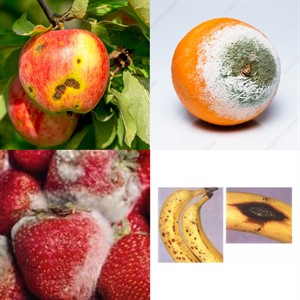
Fruit with microorganisms growing on it.
- Microorganisms are found in air, water, soil, and food items.
- They grow on fruits, vegetables, and moist surfaces, causing spoilage.
- Some microbes also live inside our body, especially in the digestive system.
- They show diversity in shape, size, and structure such as spherical, rod-shaped, or irregular forms.
This shows that microorganisms continuously interact with our environment and daily life.
Microorganisms as nature’s cleaners:
Activity 1
Take an empty container and fill it halfway with garden soil. Add some fruit and vegetable peels, then cover them with another layer of soil and leave the container undisturbed for \(2–3\ weeks\). After this period, observe the contents carefully.
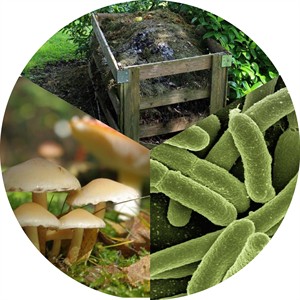
Manure and decomposers
- Microorganisms decompose plant waste and animal waste and turn it into compost, but they do not decompose inorganic materials such as polythene, plastic bags and plastic toys.
-
Convert waste into manure, which enriches soil fertility.
-
Help recycle nutrients in nature.
-
Certain bacteria, like Bacillus, are capable of decomposing waste and sewage in the water. Hence, they aid in naturally cleaning water.
Important!
Ancient Indian texts like the Vedas and Atharvaveda mention ‘Krimi’, referring to visible and invisible tiny organisms and describing both their beneficial and harmful effects.
Biogas:
Some microorganisms decompose plant and animal waste in oxygen-free conditions and release biogas rich in methane, which is used as a fuel for cooking, heating, electricity generation, and vehicles.
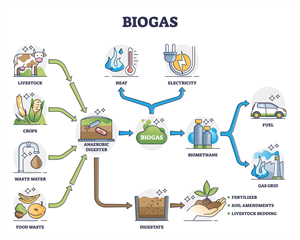
Biogas
Dr Ananda Mohan Chakrabarty (\(1938\)–\(2020\)) developed an oil-degrading bacterium in \(1971\), which was patented in \(1980\), detailing how microbial processes neutralise pollutants and shield the environment..
Microorganisms and food:
Activity
Prepare dough with yeast in bowl A and without yeast in bowl B. Keep both warm for \(4-5\ hours\), and observe the increase in volume due to yeast activity.
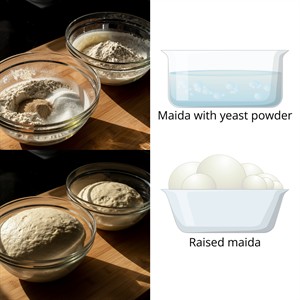
Action of yeast in dough (fermentation)
Yeast:
- Yeast, a type of fungus, breaks down sugar and releases carbon dioxide, making dough soft and fluffy.
- This process helps in making bread, cakes, and bakery products.
- Yeast works best in warm conditions, which helps the dough rise faster. It also produces a small amount of alcohol, giving a distinct smell to the dough.
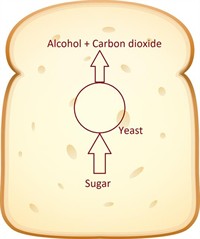
Action of yeast during bread formation
Curd:
Activity 4:
Add curd to warm milk (A) and cold milk (B), keep them in warm and cool places respectively, and observe how temperature affects curd formation.
- Lactobacillus is a type of bacteria that aids in the production of curd.
- When a small amount of curd introduces bacteria into milk, Lactobacillus bacteria convert the lactose sugar in the milk to lactic acid.
- Increased acidity in milk causes casein, a protein, to coagulate or form lumps, resulting in curd formation.
\(\text{Milk}\) \(\xrightarrow{\small{\text{at 30°C to 40°C/(Lactobacillus acid bacteria)}}}\) \(\text{Curd}\).
Important!
Pickles and murabbas are protected from microbial growth due to their high salt or sugar content. High concentrations of salt or sugar remove water from microbial cells, thereby inhibiting their growth. The use of spices and oil further acts as natural preservatives, preventing spoilage.
Microorganisms in Agriculture:
- Rhizobium bacteria live in the root nodules of leguminous plants and convert atmospheric nitrogen into a form usable by plants, enriching the soil and reducing the need for chemical fertilisers through a beneficial symbiotic relationship.
- For farmers, this relationship is of great importance. If they grow grams, peas, moong, beans, and other legumes, nitrogenous fertiliser usage will reduce.
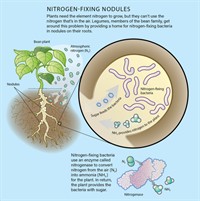
Process of nitrogen fixation
3. Microalgae – Tiny Helpers
- Microalgae produce oxygen through photosynthesis
- Used as food supplements (e.g., Spirulina, Chlorella, and Diatoms)
- Help clean water and produce biofuel.
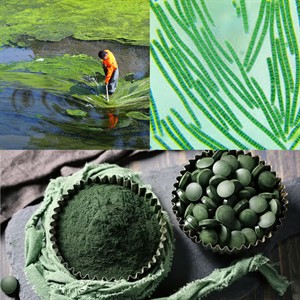
Growing and uses of microalgae as medicines
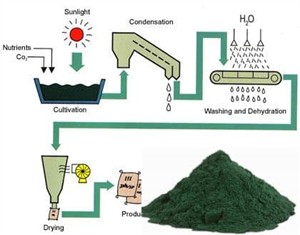
Spirulina - Super food
 Register for free to see more content