


PUMPA - SMART LEARNING
எங்கள் ஆசிரியர்களுடன் 1-ஆன்-1 ஆலோசனை நேரத்தைப் பெறுங்கள். டாப்பர் ஆவதற்கு நாங்கள் பயிற்சி அளிப்போம்
Book Free DemoWhen our body is healthy, all organs and organ systems work normally. When we become unwell, the body shows signs and symptoms that help us recognize that something is wrong.
Symptoms and signs :
To understand illness, it is essential to distinguish between what we feel internally and what others can observe externally.
| Signs | Symptoms |
|---|---|
| Changes that can be observed or measured by others | Feelings or experiences reported by the patient |
| Objective (visible, measurable) | Subjective (felt personally) |
| Fever (measured with thermometer), rashes (seen on skin), swelling, cough | Headache, dizziness, nausea, fatigue, stomach pain |
| Detected by doctors, caregivers, or instruments | Felt and described by the patient |
| Can be scientifically confirmed |
Relies on the patient’s description
|
What are Pathogens?
Pathogens are disease-causing organisms that enter the body and cause infections.
| Pathogen Type | Example Diseases |
|---|---|
| Bacteria | Typhoid, Tuberculosis, Cholera |
| Viruses | Influenza (Flu), Chickenpox, Dengue, Hepatitis A |
| Fungi | Ringworm (Fungal Skin Infection) |
| Protozoa | Malaria |
Pathogens can enter the body through air, food, water, skin, or insect bites and may affect different organs such as the lungs, intestine, liver, skin, or blood.
Disease:
A disease is a condition that disrupts the normal functioning of the body or mind, causing ill health.
Diseases can be classified based on duration and the area affected.
a. Based on duration, acute diseases last for a short period (e.g., cold, typhoid), while chronic diseases persist for a long time (e.g., tuberculosis, diabetes).
b. Based on the area affected, organ-specific diseases affect a particular organ (e.g., hepatitis), whereas systemic diseases affect the whole body or multiple organs (e.g., blood-borne infections).
Based on the mode of transmission diseases are classified as Communicable disease and Non-communicable diseases.
Communicable or infectious diseases:
Communicable or infectious diseases are diseases caused by pathogens that spread through air, water, food, or vectors. Louis Pasteur proposed the germ theory of disease.
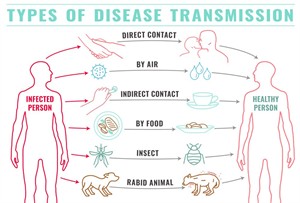
Transmission of diseases
1. Air borne diseases:
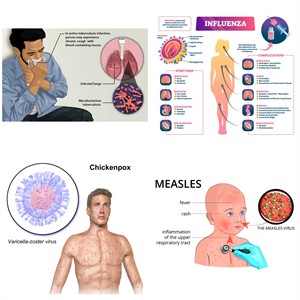
TB, Influenza, Measles and Chickenpox (clockwise)
| Disease | Causative Agent | Site of Infection | Symptoms | Preventive Measures |
|---|---|---|---|---|
| Tuberculosis (TB) | Mycobacterium tuberculosis (Bacterium) | Lungs (Respiratory tract) | Long cough, chest pain, fever, weight loss, night sweats | BCG vaccination, covering mouth while coughing, good ventilation, avoiding overcrowding |
| Influenza (Flu) | Myxovirus | Nose, throat, and lungs | Sudden fever, sore throat, body aches, runny nose, tiredness | Annual flu vaccine, handwashing, wearing masks, adequate rest, proper hydration |
| Measles | Rubeola virus | Respiratory tract and skin | High fever, red rash, runny nose, cough, watery eyes | MMR vaccine, avoiding contact with infected persons, balanced diet |
| Chickenpox | Varicella-zoster virus | Respiratory tract and skin | Itchy blisters, fever, tiredness, loss of appetite | Varicella vaccine, isolation of patients, personal hygiene |
| Common Cold | Rhinovirus | Nose and throat | Sneezing, runny nose, mild fever, sore throat, headache | Good hygiene, handwashing, adequate rest, avoiding close contact with infected individuals |
2. Food and Water borne disease:
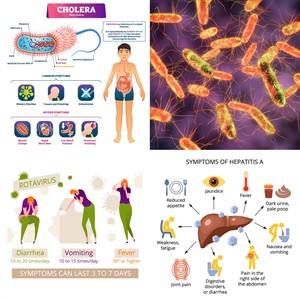
Cholera, Typhoid, Hepatitis A and Diarrhoea
| Disease | Causative Agent | Site of Infection | Symptoms | Preventive Measures |
|---|---|---|---|---|
| Cholera | Vibrio cholerae (Bacterium) | Intestine | Severe diarrhoea, dehydration, vomiting | Boiled/filtered water, ORS, food hygiene |
| Typhoid | Salmonella typhi (Bacterium) | Intestine | Prolonged fever, stomach pain, constipation/diarrhoea | Typhoid vaccine, safe water, proper sanitation |
| Hepatitis A | Hepatitis A virus | Liver | Jaundice, fever, nausea, loss of appetite | Safe food and water, Hepatitis A vaccine, handwashing |
| Diarrhoea | Rotavirus | Intestine | Loose stools, weakness, dehydration | Clean water, hygienic cooking, proper waste disposal |
3. Vector borne diseases:
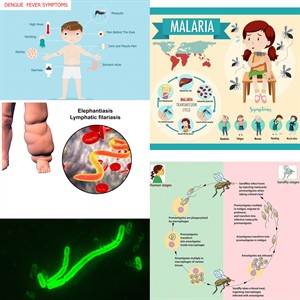
Dengue, Malaria, Kala-azar, Plague and Filariasis (clockwise)
| Disease | Causative Agent | Site of Infection | Symptoms | Preventive Measures |
|---|---|---|---|---|
| Malaria | Plasmodium (Female Anopheles mosquito) | RBC, liver | Fever with chills, sweating, weakness | Mosquito nets, insect repellents, draining stagnant water |
| Dengue | Dengue virus (Aedes aegypti mosquito) | Blood, skin | High fever, headache, muscle and joint pain, weakness | Mosquito nets, repellents, eliminating stagnant water |
| Filariasis | Wuchereria bancrofti | Lymphatic system | Swelling of legs/genitals (elephantiasis) | Mosquito control, preventive drug treatment |
| Plague | Yersinia pestis | Lymph nodes, lungs | Fever, swollen lymph nodes, weakness | Control of rats and fleas, improved sanitation |
| Kala-azar (Leishmaniasis) | Leishmania donovani | Spleen, liver, bone marrow | Prolonged fever, weight loss, enlarged spleen and liver | Sandfly control, insecticide spraying, early treatment |
4. Direct contact:
Diseases transmitted by direct contact spread through physical contact with an infected person or by sharing contaminated personal items such as towels, clothes, or utensils; examples include ringworm, scabies, and conjunctivitis.
5. Parasitic diseases:
Some infectious diseases are caused by parasitic worms that live inside the body, especially the digestive system; examples include roundworms (stomach pain and poor growth), hookworms (anaemia), and tapeworms (weakness).
General precautions to prevent communicable diseases:
- Maintain personal and environmental hygiene by washing hands regularly and keeping surroundings clean.
- Consume safe food and water and avoid sharing personal items.
- Prevent disease transmission through vaccination, covering coughs and sneezes, and controlling vectors like mosquitoes.
 Register for free to see more content